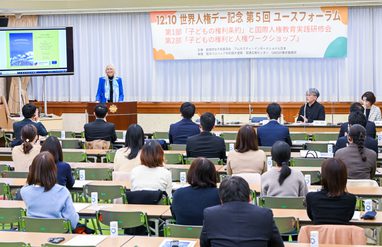
Panelists at the Youth Forum “Protecting Life: A Dialogue on Justice and Human Rights” in Tokyo
On 14 December 2025, Amnesty International Japan and the Soka Gakkai Peace Committee co-hosted the 8th Youth Forum Commemorating Human Rights Day at the Toda International Center in Tokyo. Approximately 80 people gathered under the theme “Protecting Life: A Dialogue on Justice and Human Rights,” confronting one of Japan’s most sensitive and least openly debated issues: capital punishment.
The forum took place against the backdrop of dramatic and contrasting developments in Japan’s criminal justice system. In 2024, Iwao Hakamada, who had spent nearly half a century on death row, was finally acquitted through a retrial. The case is widely recognized as one of the gravest wrongful convictions in modern Japanese history.
International pressure has also been mounting. In December 2024, the United Nations General Assembly adopted its 10th resolution calling for a moratorium on executions, with 130 of 193 member states voting in favor. Since 2007, the number of abolitionist countries worldwide has risen from 90 to 113. Africa has seen particularly notable progress, with Kenya, Morocco and Zambia supporting the resolution for the first time.
Yet Japan and the United States voted against the resolution, underscoring the significance of creating spaces for domestic dialogue—especially among younger generations.
The forum opened with remarks by Shinya Takeda, Campaigns Manager at Amnesty International Japan, who emphasized the importance of youth participation in shaping future justice systems. He was followed by a guest address from Kaoru Nemoto, Director of the United Nations Information Centre, Tokyo, who situated Japan’s debate within global human rights trends.
A video message from Mario Marazziti, co-founder of the World Coalition Against the Death Penalty, set a powerful tone. He framed the death penalty as a symbolic struggle between what he called a “culture of life” and a “culture of death,” urging young people to recognize their role in determining which vision prevails.
Moderated by journalist and social entrepreneur Nana Takamatsu, the panel brought together voices rarely heard in the same space:
- Kayoko Nakatani, founding member of Wings of Human Rights and a bereaved family member
- Takae Ito, member of the House of Councillors (Komeito)
- Toshio Sakamoto, non-fiction writer and former prison officer
- Midori Hontani, Youth Coordinator at Amnesty International Japan
- Mihoko Oyama, former attorney-at-law
Their discussion cut through political abstractions to reveal the human and systemic realities of capital punishment in Japan. Panelists addressed the lack of transparency in Japan’s death penalty system, from arrest to execution: the psychological burden on prison officers tasked with carrying out executions; the inadequacy of support for victims and their families; and the troubling risk of wrongful convictions, highlighted by cases like Hakamada’s.
Rather than framing the debate in simple “for or against” terms, speakers emphasized the need to ask deeper questions: What does justice truly mean? Whose lives are protected—and whose are expendable? Can a system that takes life uphold human dignity?
In the second half of the program, participants engaged in group discussions based on emotionally challenging scenarios, such as, “What if someone precious to me were killed?” or “What if someone close to me were arrested?”
These conversations pushed attendees to move beyond abstract policy debates and confront the moral complexity of punishment, forgiveness, fear and empathy. Each group shared their reflections in a plenary session, creating a space of collective learning and mutual respect.
As one participant noted, the exercise transformed the issue from a distant political topic into a deeply personal question about what kind of society people wish to live in.
The program concluded with closing remarks by Shuichi Minami, Chair of the Soka Gakkai Youth Peace Committee, who urged young people to carry forward the spirit of dialogue and action.