The seventieth session of the UN Commission on the Status of Women (CSW) was historic in several ways. Prior to the session, the CSW convened its first Multistakeholder Hearing where various constituents shared their inputs on the Priority Theme. It addressed the theme of access to justice for all women and girls for the first time, confronting discriminatory legal frameworks that persist. As the UN Secretary-General’s Report states, “Globally, women have 64 percent of the legal rights of men.”
The session opened on 9 March 2026, and the outcome document was adopted by vote on the same day. Historically, the CSW Agreed Conclusions have only been adopted through consensus; this year’s departure from that tradition reflects the global backlash and regressive trends that have emerged in recent years. Since its first session in 1947, the CSW has served as a global norm-setting body for issues concerning women and girls’ human rights, influencing international treaties and national policies. As the largest intergovernmental convening on gender equality and largest UN gathering of feminist and women’s rights organizations, the CSW also provides a space to reenergize and recommit to working for the advancement of women and girls worldwide.

Maritza Chan Valverde (center), Permanent Representative of Costa Rica to the United Nations and Chair of the seventieth session of the Commission on the Status of Women, chairs the opening of Seventieth Session of the Commission on the Status of Women. | Photo credit: UN Photo/Evan Schneider
SGI’s contributions to the annual CSW session have been to introduce and expand the conversations on the annual theme based on our priorities, guided by 40 years of peace proposals that offer solutions to societal problems through the perspective of Buddhism. Inspired by the Soka Gakkai Women’s Peace Committee, who have been contributing to women’s empowerment through their activities to promote the culture of peace locally and throughout Japan for over four decades, SGI’s recent focus has been on women and young women’s leadership and their important role in peacebuilding.
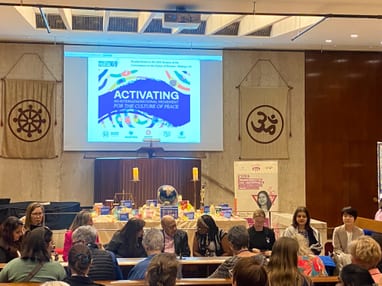
In 2025, SGI joined with 10 organizations to form the Culture of Peace for Gender Equality Initiative. This group organized an NGO CSW70 parallel event on “Women’s Leadership Advancing Disarmament, Justice and Culture of Peace” held on 11 March 2026. The topic was partly inspired by the upcoming election for a new UN Secretary-General (SG) in 2026. Because only men have served this role in its 80-year history, there is much talk of and campaigning for a woman SG. The initiative members wanted to emphasize how important it will be for this new UN leader, regardless of gender, to boldly stand for disarmament and the culture of peace. The parallel event aimed to highlight the intersections of women’s leadership, disarmament and justice through a human-centric lens. By focusing on women peacebuilders, including a nuclear test survivor, and their experiences, the event challenged traditional narratives that portray women solely as victims, instead emphasizing their agency, resilience and critical role in advancing the culture of peace.
-

Ivy Koek of SGI moderated the NGO CSW70 parallel event on “Women’s Leadership Advancing Disarmament, Justice and Culture of Peace”
-

Panelists at the parallel event on “Women’s Leadership Advancing Disarmament, Justice and Culture of Peace” explored what compassionate leadership meant to them
-

Some of the speakers and organizers of the parallel event “Women’s Leadership Advancing Disarmament, Justice and Culture of Peace” gathered for a meet and greet
To open the event, moderator Ivy Koek of SGI shared from SGI’s 2000 peace proposal, saying, “Humanity is charged with the task of not merely achieving a passive peace, the absence of war, but of transforming on a fundamental level those social structures that threaten human dignity. And only in this way can we realize the positive, active values of peace.” This was followed by opening remarks from Adedeji Ebo, UN Director and Deputy to the High Representative for Disarmament Affairs; Doris Mpoumou, Special Representative to the African Union Commission and United Nations Economic Commission for Africa, representing UN Women; Casey Harden, CEO/General Secretary of World YWCA; and Sylvie Ndongmo, President of the Women’s International League for Peace and Freedom.
Film producer and third-generation survivor of nuclear exposure, Aigerim Seitenova shared about her film JARA, which explores how four decades of nuclear testing have disproportionately impacted women in Kazakhstan. During a fireside chat, Dr. Ivana Nikolić Hughes, President of the Nuclear Age Peace Foundation, and Dr. Jasmin Nario-Galace, Senior Program Director of the Global Network of Women Peacebuilders, spoke about what compassionate leadership meant to them and shared through personal stories what motivates their work. Additionally, Miyuki Kawaoka of SGI presented the initiative’s Ambassadors for the Culture of Peace for Gender Equality Pilot Program, which is anticipated to start later in 2026.